Hub, Federated, or Hybrid: Choosing the Operating Model That Actually Fits
Part 6 of 10: Two models get pitched as the only choices — fully embed or spin up an independent P&L. Both are wrong at scale. This post scores all three operating models across six criteria and makes the case for the hybrid hub-and-spoke, with the full org and relationship model.
*Series: The AI Practice Playbook: From Zero to Agentic at Scale — Post 6 of 10 | aiorbitx.com*
*Industries covered across this series: BFSI, healthcare, pharma, manufacturing, retail, logistics.*
01 — Executive Hook
Two models get pitched as the only choices: fully embed your AI talent inside the existing cloud accounts, or spin up an independent P&L parallel to cloud. Both are wrong at scale.
The model that wins when you're serving hundreds of clients across multiple regions is neither pure extreme — it's a hub that owns standards and talent, with spokes that stay embedded where the client relationship already lives.
02 — The Problem
- Picking A because it's fast, without planning for its ceiling — AI priorities get deprioritised behind core cloud work, and governance becomes inconsistent account to account.
- Picking B because it feels cleaner, without planning for the ramp — slow to build client trust and pipeline from scratch, and real risk of channel conflict with existing account teams.
- Dismissing the hybrid as indecision — when at the scale of a multi-region practice serving hundreds of clients, it wins or ties on almost every dimension that matters.
03 — The Maturity Question
Don't start by asking "hub or federated." Weigh what actually matters for your context across six criteria: speed to market, governance consistency, talent retention, P&L clarity, scalability, and channel-conflict risk. Score your leadership's actual priorities before looking at the comparison below.
04 — The Framework: Three Operating Models
- A — Federated / Embedded. AI talent embeds inside existing Cloud Practice accounts; the account lead owns the client P&L.
- B — Independent Centralised Practice. A stand-alone AI P&L, parallel to Cloud, reporting to the CTO/CDO with dedicated headcount.
- C — Hybrid Hub-and-Spoke. A central Hub owns standards, IP, governance and the FDE talent pool; spokes are FDE pods embedded inside each Cloud Practice vertical.
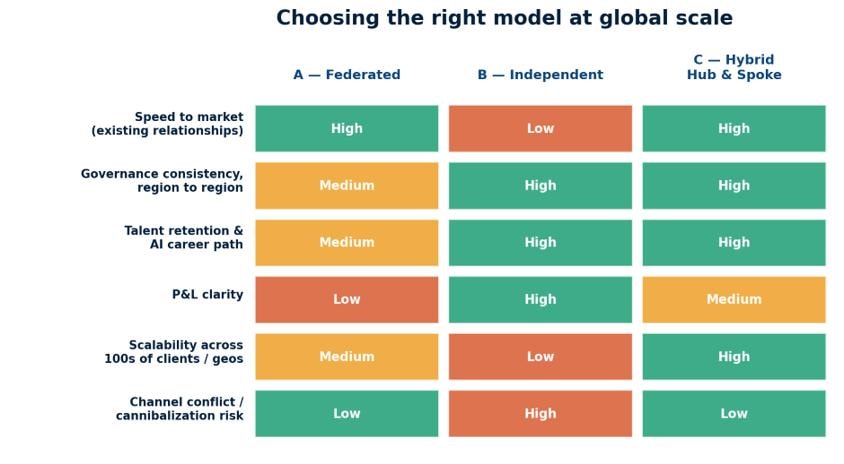
Option C wins or ties on every dimension that matters at scale — speed, governance, talent, and multi-region scalability — while trading a small amount of P&L purity for far lower channel-conflict risk.
05 — Operating Model: The Recommended Hybrid Hub-and-Spoke
This is the section the rest of the series has been pointing to, so it gets full treatment here.
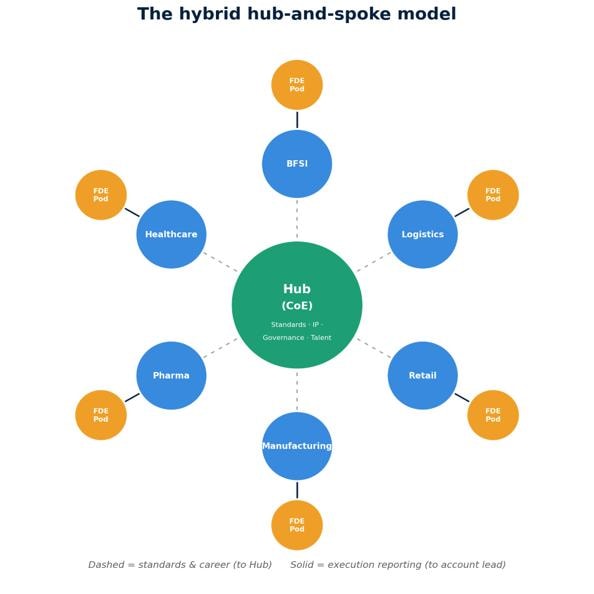
The reporting structure is the detail that makes this work: FDEs sit solid-line with the account or region delivery lead for engagement execution, and dashed-line with the Hub for standards, evaluation, and career progression. The account lead decides what gets built and when. The Hub decides whether it was built well, and whether the person who built it gets promoted.
Why this wins at scale: decades of client trust already sit with the account teams, so spokes plug straight into existing relationships with no new go-to-market motion. One Hub protects scarce FDE talent and enforces a consistent Responsible AI bar across every region. New industries or geographies become new spokes without re-architecting the model.
06 — Organisation: The Full Org and Relationship Model
An Executive Sponsor sits above both the AI Practice Head and the Cloud Practice Head as peers — this peer relationship is what prevents the channel conflict Option B risks and the deprioritisation Option A risks.
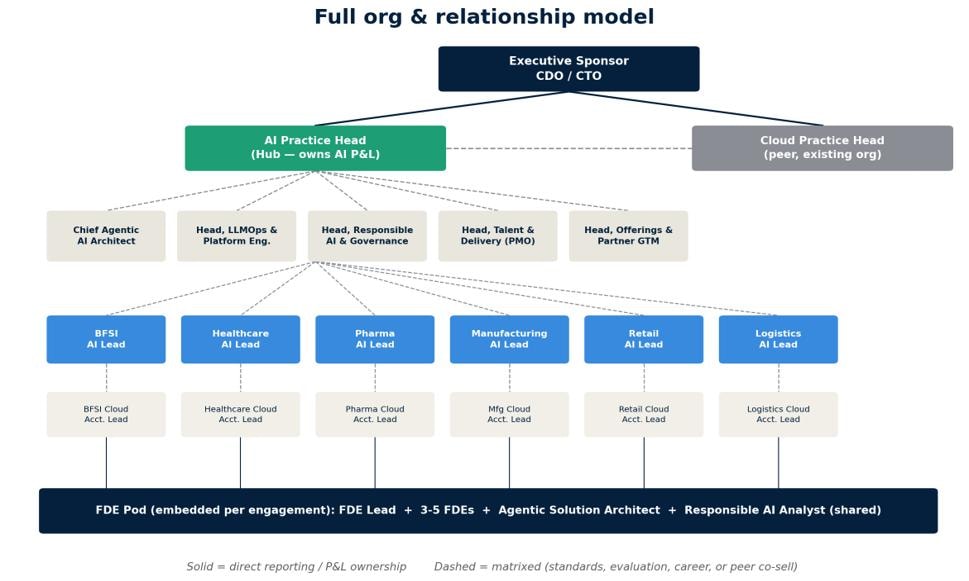
Each industry gets a Vertical AI Lead, matrixed against that industry's existing Cloud Account Lead. The FDE pod itself is deliberately small and consistent across every vertical, which is what lets a new spoke stand up quickly — the template doesn't change, only the industry label does. Full RACI in Post 9.
07 — Delivery *(previewed here, full treatment in Post 7)*
Delivery runs across five lanes simultaneously — the FDE pod, existing application engineering, existing cloud platform, security and governance, and client stakeholders — each with a different role at each stage. The FDE pod leads discovery and build; existing teams pair from day one, so production handover is a formality.
08 — Technology *(previewed here, integrated into Post 5 and Post 7)*
The Hub standardises on a short list of platforms per layer, specifically to control support burden across every spoke. Exceptions require Hub architecture review, not ad-hoc project choice.
09 — Economics *(previewed here, full treatment in Post 8)*
The Hub carries shared platform and governance cost; each spoke's FDE pod is typically costed against the account or vertical it serves. P&L clarity is honestly only medium, not high — worth naming explicitly to finance rather than overselling.
10 — Business *(previewed here, full treatment in Post 8)*
Spokes sell on speed, using relationships that already exist; the Hub sells on consistency — one Responsible AI bar, one talent pipeline, one place reusable IP compounds.
11 — Roadmap
- Days 1–30: Charter the Hub, name an executive sponsor, pick the first two spokes.
- Days 31–90: Stand up two FDE pods with borrowed capacity; draft the governance baseline.
- Months 3–6: Ship production pilots from both spokes; publish the first accelerator kit; formalise partner co-sell agreements.
- Months 6–12: Open two to three additional spokes; stand up platform v1; establish the formal Responsible AI review board.
- Months 12–18: Multi-region delivery pods across all priority verticals; approaching self-funding headcount economics.
12 — Executive Checklist: What a CIO/CTO Should Do Monday Morning
- ☐ Name an executive sponsor and an AI Practice Head as a peer to the existing Cloud Practice Head
- ☐ Pick the two spokes most ready to prove the model, not the loudest internal advocates
- ☐ Approve a governance charter for the Hub before the first spoke goes live
- ☐ Confirm every FDE pod's dual reporting line is written down before the first engagement starts
- ☐ Ask finance to accept "medium" P&L clarity explicitly, in exchange for lower channel-conflict risk
13 — Quick Check
One-question self-check: if your AI talent is embedded inside an account team today, who decides whether that person gets promoted — the account lead, or a practice-wide standard? If nobody can answer that cleanly, you don't have a Hub yet.
The full self-assessment, with automatic scoring across Cloud, AI/ML, and Agentic AI, is in the Post 1 companion workbook — Practice Maturity Self-Assessment.xlsx.
14 — Closing Thought
The organisations that get this wrong pick an extreme and defend it past the point it's working. The organisations that get it right build a Hub that owns exactly two things — standards and talent — and let everything else stay where it already works. That's not a compromise. At the scale most of this series is written for, it's the only version of federation that survives contact with a hundred accounts.
*Next in the series — Post 7: Delivery Models and Engagement Structures — the five-lane delivery model this post previewed, matched to the operating model and grid cell each fits.*
*Sai Bharat Sripathi is a technical leader and enterprise AI architect building and scaling Cloud, AI/ML, and Agentic AI practices across BFSI, healthcare, pharma, manufacturing, retail, and logistics. This is Post 6 of a 10-part series on aiorbitx.com.*