
The Maturity Map: Why Your AI Practice and Your Partner's AI Practice Are Never at the Same Level — and Why That's the Whole Problem
Every failed AI or agentic AI program has this pattern somewhere in it — not a bad model, not a bad use case, but a maturity mismatch that nobody diagnosed before the SOW was signed. This post introduces the two-axis framework that fixes that.
*Series: Building the AI-native enterprise — a practitioner's playbook for scaling Cloud, AI and Agentic AI practices*
*Post 1 of 10 | aiorbitx.com*
*Industries covered across this series: BFSI, healthcare, pharma, manufacturing, retail, logistics.*
01 — Executive hook
Here is a sentence I've said in more steering committees than I can count: "Your problem isn't that you lack an AI strategy. It's that you and your delivery partner are trying to execute two different maturity levels through one contract."
Every failed AI or agentic AI program I've been called in to unwind has this pattern somewhere in it — not a bad model, not a bad use case, but a maturity mismatch that nobody diagnosed before the SOW was signed. A customer at governance Level 1 hires a partner selling a Level 4 platform play. A customer with a Level 3 internal CoE hires a partner still improvising delivery at Level 1. Both sides talk past each other in the same steering meeting, using the word "practice" to mean completely different things.
This is true whether the customer is a bank building a fraud-detection agent, a pharma company standing up an AI-assisted trial-matching pilot, a manufacturer piloting predictive maintenance, or a logistics operator automating exception handling. The industry changes; the maturity mismatch pattern doesn't.
This series exists to fix that — with a framework, not a slogan.
02 — The problem
Three patterns show up constantly, across every industry I work in — BFSI, healthcare, pharma, manufacturing, retail, logistics:
- The vendor assumes it's always ahead. Most partner-authored maturity content scores the client and quietly assumes the IT firm is automatically more advanced. In regulated industries like BFSI and pharma, the enterprise CoE is often more disciplined on governance than the systems integrator pitching it.
- Maturity gets treated as one number. A retail chain can be genuinely L4 on cloud and still L1 on agentic AI — three different disciplines, three different levels, inside the same organization.
- Nobody diagnoses before they prescribe. Operating model, delivery model, budget ask, and timeline get decided before anyone has honestly scored where the organization — and the partner — actually stand.
The fix isn't more strategy decks. It's a shared, honest diagnostic both sides use before the engagement is scoped.
03 — The maturity question
Before you read another section of this series, answer this for your own organization — and separately for whoever you're partnering with:
- Where does our cloud practice sit, independent of AI?
- Where does our AI/ML practice sit — funded pilots vs. a real CoE vs. a platform?
- Where does our agentic AI practice sit — almost certainly the least mature of the three?
- Is the partner we're evaluating ahead of us, behind us, or aligned — on each dimension separately?
04 — The framework
The four maturity levels
The same four levels apply whether you're scoring a customer organization or an IT firm, and whether you're scoring cloud, AI, or agentic AI. Score each dimension separately — a company can be L4 on cloud and L1 on agentic AI simultaneously, and usually is.
| Level | Name | What it looks like |
|---|---|---|
| L1 | Ad hoc | Pilots exist. No repeatable delivery pattern. No governance forum. Success depends on specific individuals, not process. Funding is per-project, justified case by case. |
| L2 | Foundational | A practice charter exists. Some reusable assets and templates exist but aren't consistently maintained or mandated. Governance exists on paper more than in cadence. Still project-funded. |
| L3 | Managed | A funded Center of Excellence or practice with its own cost center. Repeatable delivery patterns are standard, not exceptional. Governance forum meets on a defined cadence. Standard KPIs are tracked. |
| L4 | Optimized | The practice operates as a platform: self-service enablement, an internal accelerator/pattern catalog, measurable ROI attribution per engagement, and a genuine cross-business-unit federation model. Funding is platform-based, not project-based. |
The two-axis model
This is the piece most maturity models skip: plot the customer's level against the IT firm's level, on the same grid, for the same dimension. The diagonal — where both sides are at the same level — is where relationships run smoothly. Off-diagonal cells are where 80% of failed engagements live.
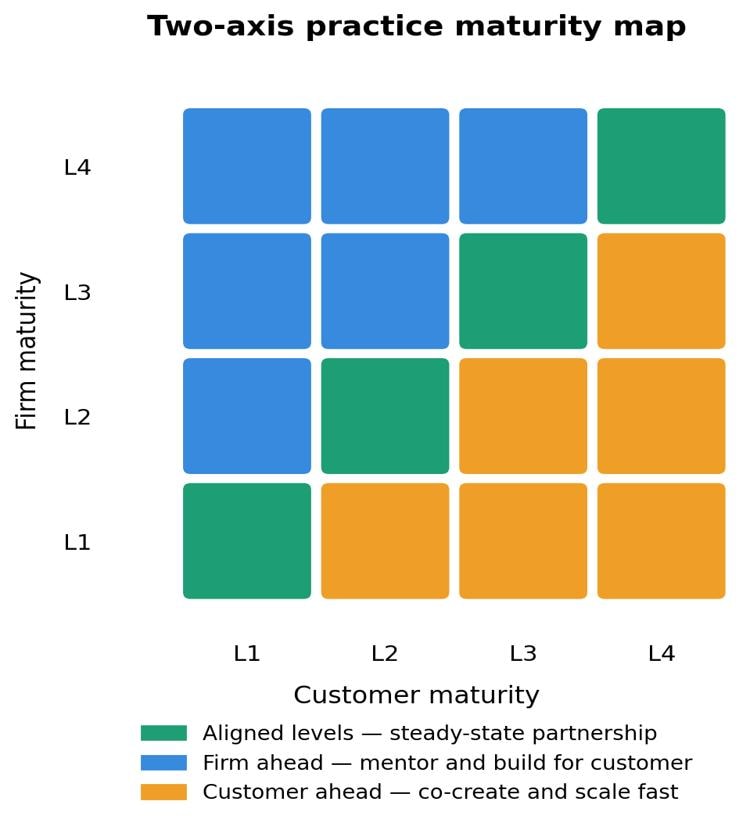
- On the diagonal (aligned): steady-state partnership — governance cadence and delivery patterns are co-designed.
- Above the diagonal (firm ahead): the firm mentors and builds — raising the customer's governance and funding model before scaling scope.
- Below the diagonal (customer ahead): the customer co-creates and scales — bringing the firm repeatable patterns and delivery capacity it doesn't yet have.
Every subsequent post in this series maps to a specific move on this grid: starting from zero (Post 3), integrating AI into an existing cloud practice (Post 4), industrializing an existing practice (Post 5), and then the operating model, delivery model, economics, and roadmap mechanics that make each move real (Posts 6–10).
05 — Operating model *(previewed here, full treatment in Post 6)*
The right operating model — hub, federated, or hybrid — is a function of where you sit on the grid, not a matter of taste. Post 6 covers this with the actual team-relationship diagrams.
06 — Organization *(previewed here, full treatment in Posts 6 and 9)*
Who owns governance, delivery, and the customer relationship changes meaningfully by maturity level. Full RACI comes in Post 9.
07 — Delivery *(previewed here, full treatment in Post 7)*
Delivery model — practice-as-a-service, staff-augmented pods, managed practice, or a co-innovation lab — should match the grid cell you're in. Post 7 walks through the decision.
08 — Technology *(previewed here, integrated into Posts 4, 5 and 7)*
Platform and tooling requirements scale with maturity level, and with the regulatory regime you sit in — HIPAA and GxP for healthcare/pharma, PCI DSS and RBI/SOX-class rules for BFSI.
09 — Economics *(previewed here, full treatment in Post 8)*
Budget bands, funding mechanisms, and realistic ROI timelines differ by an order of magnitude between an L1→L2 move and an L3→L4 move — and by industry. Post 8 is the one to bookmark for the business case.
10 — Business *(previewed here, full treatment in Post 8)*
How the practice generates measurable value — cost avoidance, revenue enablement, delivery margin, or innovation pipeline — depends on maturity level and industry.
11 — Roadmap
Regardless of which cell you're in, the first 30 days look the same:
- Days 1–30: Score your organization and your partner independently, on all three dimensions, using Section 13 below or the companion Excel workbook.
- Days 31–60: Identify your grid cell for each dimension and read the corresponding post (3, 4, or 5) before scoping any new engagement.
- Days 61–90: Bring the assessment results into your next steering committee as a shared artifact, not a private scorecard.
The full 6/12/24-month roadmap builds on this diagnosis and is covered in Post 10.
12 — Executive checklist: what a CIO/CTO should do Monday morning
- ☐ Score your cloud, AI, and agentic AI practices separately — not as one number
- ☐ Ask your primary delivery partner to score themselves, on the same three dimensions
- ☐ Compare notes in the next steering committee — don't let the gap surface in a delivery review
- ☐ Identify which of the nine starting positions (Post 2) your organization occupies
- ☐ Hold any new AI or agentic AI RFP until this diagnosis is done
13 — Maturity self-assessment
Quick check: on a scale of 1 (ad hoc) to 4 (optimized), how would you score your organization's governance for agentic AI specifically — a funded, cadenced forum, or nothing formal at all?
Score each row 1 (L1) to 4 (L4) for your own organization, then repeat separately for your primary delivery partner or client. This works identically for a customer-side leader in any industry — BFSI, healthcare, pharma, manufacturing, retail, logistics — or an IT firm leader scoring their own practice.
| Dimension | L1 | L2 | L3 | L4 |
|---|---|---|---|---|
| Governance | No formal governance; ad hoc per deal | Charter exists, not consistently enforced | Funded governance forum, regular cadence | Self-service guardrails, automated not manually reviewed |
| Funding model | Project by project, no dedicated budget | Some seed budget, justified per opportunity | Own cost center or P&L line | Platform-funded with measurable ROI attribution |
| Delivery repeatability | Every engagement starts from a blank page | A few templates exist, not maintained | Standard repeatable patterns and accelerators | Delivery packaged as a versioned internal product |
| Tooling and reuse | No shared tooling | Common toolchain recommended, not required | Curated toolchain mandated org-wide | Self-service tooling catalog with usage telemetry |
| Team structure | No dedicated team, borrowed capacity | Small core team alongside delivery teams | Staffed CoE, defined roles and career paths | Federated — CoE plus embedded champions per BU |
| Value measurement | No consistent measurement | Anecdotal wins, no standard metrics | Standard KPIs, reported regularly | ROI attributed per engagement, feeds innovation pipeline |
Scoring: average your six scores. 1.0–1.5 = L1. 1.6–2.5 = L2. 2.6–3.5 = L3. 3.6–4.0 = L4. Do this for yourself and for your partner, then plot both points on the two-axis grid above.
A companion Excel workbook runs this same exercise across Cloud, AI/ML, and Agentic AI, with automatic scoring and an auto-generated version of the grid above once you and an estimate of your partner's maturity are both entered.
14 — Closing thought
I've never seen an AI or agentic AI program fail because the technology didn't work. I've seen plenty fail because two organizations, each convinced they understood "maturity," were never actually talking about the same axis. The framework in this post isn't clever for its own sake — it's the diagnostic step that every subsequent decision in this series depends on. Score honestly before you scope anything. Everything else in this series assumes you did.
*Next in the series — Post 2: Nine starting positions — the concrete scenarios you'll recognize your organization in, mapped directly to the grid above.*