
Industrializing an Existing Practice: From Project-Funded to Platform-Funded
Part 5 of 10: A funded, working AI practice at L3 is a genuine achievement — and the stage where most practices stall. This post covers the four levers of industrialization, the FDE delivery model, the role taxonomy, and the headcount ramp that makes the practice self-funding by month 18.
*Series: The AI Practice Playbook: From Zero to Agentic at Scale — Post 5 of 10 | aiorbitx.com*
*Industries covered across this series: BFSI, healthcare, pharma, manufacturing, retail, logistics.*
01 — Executive Hook
A funded, working AI practice at L3 is a genuine achievement — most organisations never get there. It's also the stage where I see the most talented practices stall, because the skills that built an L3 CoE are not the skills that turn it into an L4 platform.
Industrialisation isn't more of the same work, done harder. It's a different kind of work entirely — and it needs a different talent model to carry it.
02 — The Problem
- The CoE becomes a bottleneck by design — everything routes through the same centralised team that built the practice.
- Reuse stays informal — patterns live in one senior engineer's head, not a discoverable catalog.
- Funding stays project-shaped — every new business unit has to make its own case from scratch.
- Federation gets attempted without a delivery mechanism — "federate" sounds like an org-chart decision, but it only works with a concrete role that actually embeds and ships.
03 — The Maturity Question
This post is for you if Post 1 scored your practice at L3 on most dimensions — funded, governed, repeatable — but not yet self-service, platform-funded, or federated. The question is: which of the four levers below is holding you at L3, and what's the actual delivery mechanism that pulls each one?
04 — The Framework: The Four Levers of Industrialisation
- 1Funding model. From an annually justified cost centre to platform funding via chargeback or showback tied to measurable usage.
- 2Enablement. From a delivery team that gates every request to a self-service developer portal within automated guardrails.
- 3Reuse. From informally shared patterns to a versioned internal pattern marketplace with adoption telemetry.
- 4Federation. From a centralised CoE handling all delivery to a CoE plus an embedded delivery role in every business unit.
The order matters: reuse has to be real before self-service is safe, and self-service has to be working before federation will actually reduce load on the CoE. Funding can move in parallel.
05 — Operating Model: The Delivery Mechanism Behind Lever 4
Federation fails as an abstraction; it succeeds as an operational role. The single most effective mechanism for executing Lever 4 is the Forward Deployed Engineer (FDE): a senior, full-stack AI practitioner who embeds directly within a business unit's engineering squad for an 8- to 12-week deployment cycle.
The FDE builds against production constraints and real enterprise data, driving the initiative through discovery, architecture co-design, and production hardening. Once hardened, operational handover routes into the centralised platform operations pool — freeing the FDE to rotate into the next high-value BU use case.
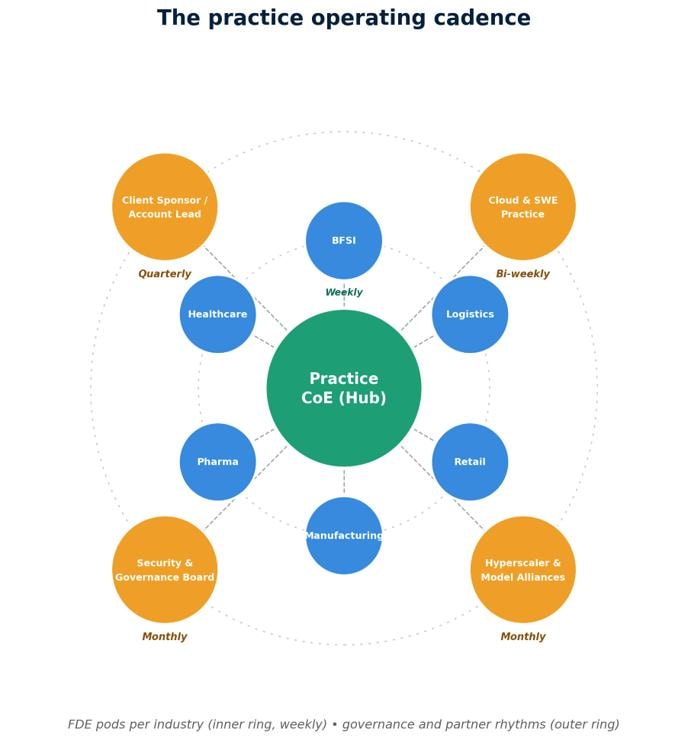
The diagram above shows the operating cadence once this is running: an inner ring of FDE pods, one per industry vertical, meeting weekly with their account delivery lead. An outer ring of governance and partner relationships on slower cadences — bi-weekly reuse review, monthly governance, quarterly business reviews. The CoE at the centre owns standards, the pattern library, and the FDE talent pool — not the delivery itself. Full hub vs. federated vs. hybrid comparison is in Post 6.
06 — Organisation: The Role Taxonomy and Talent Pipeline
Scaling an AI practice requires six differentiated roles beyond general application engineering:
- 1Forward Deployed Engineer (FDE): Embedded build lead driving BU integration sprints.
- 2Agentic Solution Architect (ASA): Reference architecture, multi-agent framework selection, and cross-cloud topology.
- 3LLMOps / Platform Engineer: Automated eval pipelines, observability, latency guardrails, and dynamic cost routing.
- 4Responsible AI (RAI) Lead: Policy-as-code implementation, safety testing, red-teaming, and regulatory compliance mapping.
- 5Delivery / Practice Manager: Pod utilisation, cross-vertical staffing (maintaining a ratio of 1 FDE Lead per 4–6 FDEs), P&L, and engagement governance.
- 6Offering & Partner Lead: Packaged solution blueprints, hyperscaler co-sell frameworks, and commercial pricing models.
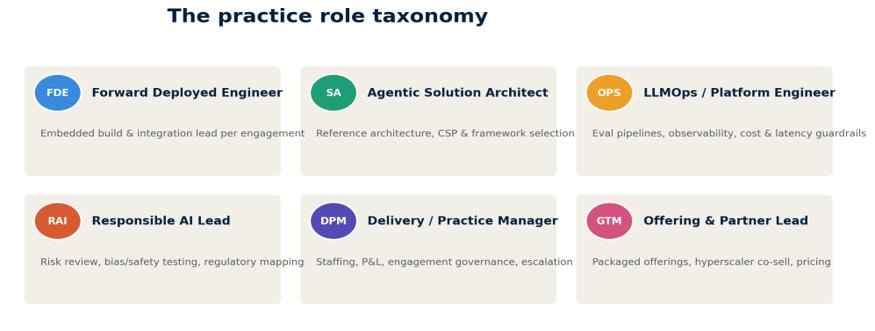
Roughly 60% of this capacity comes from reskilling internal cloud talent rather than competing on the open market. Existing Cloud Solution Architects elevate into Agentic SAs; DevOps engineers transition into LLMOps specialists; and senior engineers complete a targeted 6–10 week bootcamp and shadow rotation to become certified FDEs. External hiring is preserved strictly for niche, scarce specialties. Full RACI in Post 9.
07 — Delivery
Delivery shifts from the CoE shipping engagements to the CoE shipping capability and talent that FDE pods use to ship their own engagements. A realistic engagement lifecycle: a two-week discovery assessment, co-design of the reference architecture, a 4–8 week active embedded build sprint (anchoring the overall 8–12 week embedding window), a hardening pass, production cutover with formal handover, and then the CoE — not the FDE pod — owns steady-state operation so the pod can rotate to the next engagement.
08 — Technology
This is where the self-service portal, the pattern marketplace, and usage telemetry actually get built. Automated policy-as-code guardrails replace manual review gates. Specifically, this means implementing automated guardrail evaluation mechanisms — such as prompt safety scanners, agentic tool-execution policies, and latency/cost budget gates integrated directly into CI/CD pipelines.
In regulated industries — BFSI, healthcare, pharma — the guardrails need to encode the exact same compliance logic a human reviewer used to apply manually.
09 — Economics
Illustrative planning shape, not a quote — actual figures vary by organisation size and industry:
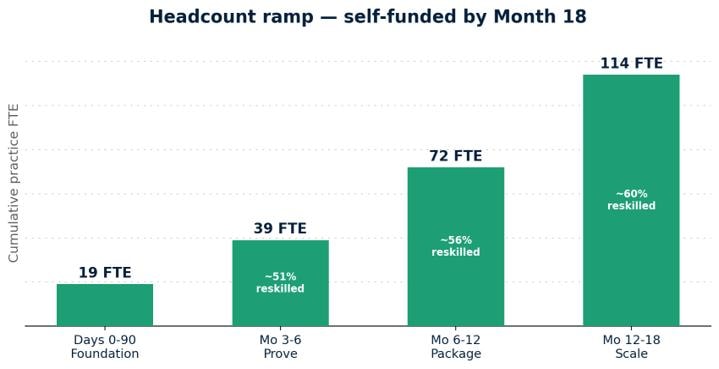
The platform investment itself is typically the single largest infrastructure spend the practice will make, but this headcount ramp is what makes the practice self-funding by around month eighteen — reskilled capacity costs a fraction of equivalent external hiring. Post 8 covers full budget bands beyond headcount.
10 — Business
The value narrative shifts from "what did this engagement deliver" to "how many business units can now self-serve, and what would it have cost to staff each of them individually with external hires". The reskilling ramp gives finance a concrete, auditable cost curve instead of an open-ended hiring request.
11 — Roadmap
- Days 1–30: Audit which lever is genuinely blocking growth; charter the FDE role formally if it doesn't exist yet.
- Days 31–90: Formalise the pattern marketplace; stand up the first one or two FDE pods, borrowed from existing delivery capacity.
- 6 months: Launch self-service enablement behind automated guardrails; run the first reskilling cohort through the FDE bootcamp.
- 12 months: Shift funding model to chargeback/showback; second and third reskilling cohorts underway.
- 18–24 months: Federate into every priority business unit with a dedicated FDE pod; headcount approaching self-funding as reskilled share stabilises around 60%.
12 — Executive Checklist: What a CIO/CTO Should Do Monday Morning
- ☐ Identify which of the four levers is actually blocking scale — don't assume it's funding
- ☐ Formalise your top three informally-shared patterns into a versioned, discoverable catalog
- ☐ Charter the FDE role explicitly — mandate, ratio guardrails (1 FDE Lead per 4–6 FDEs), named bootcamp curriculum
- ☐ Ask how much of your next 12 months of delivery capacity could realistically come from reskilling instead of hiring
- ☐ Start tracking pattern adoption telemetry now, even manually
13 — Quick Check
One-question self-check: if a business unit outside your CoE wanted to build on your existing AI patterns today, could they discover and use them without asking a person on the core team for help?
If the honest answer is no, Lever 3 (reuse) is where to start — before you charter a single FDE pod. The full self-assessment, with automatic scoring across Cloud, AI/ML, and Agentic AI, is in the Post 1 companion workbook — Practice Maturity Self-Assessment.xlsx.
14 — Closing Thought
L3 feels like arrival — a funded, governed, working practice is genuinely rare. But L3 practices that stop investing here quietly become permanent bottlenecks. The four levers in this post aren't about doing more AI work. They're about building the leverage — and naming the actual role, the FDE, that carries it — so AI work can happen without the CoE in the room every time.
*Next in the series — Post 6: Hub, Federated, or Hybrid — the operating model decision this post has been pointing toward, with the actual team-relationship diagrams for each option.*
*Sai Bharat Sripathi is a technical leader and enterprise AI architect building and scaling Cloud, AI/ML, and Agentic AI practices across BFSI, healthcare, pharma, manufacturing, retail, and logistics. This is Post 5 of a 10-part series on aiorbitx.com.*