Preference Alignment for Agentic AI: DPO, RLHF, and the Method Selector for a Tone and Citation Agent
Part 7 of 8: DPO, RLHF, GRPO, and KTO compared for Agentic AI preference alignment — with a practical method selector and a financial research agent story on tone and citation behaviour. The last step in the framework before full fine-tuning.
*Series: LLM Training & Tuning for Agentic AI — Part 7 of 8*
*Parts 1–6 covered the decision framework, prompt engineering, RAG, agent memory, LoRA/QLoRA fine-tuning, and continued pretraining. This part goes deep on Step 6 — preference alignment — with a financial research agent's tone and citation behaviour as the working example, current as of mid-2026.*
Executive Summary
Preference alignment is the last step in the decision framework before full fine-tuning and pretraining, and it solves a genuinely different problem than everything before it: not new knowledge, not a specific task format, but a shift in the model's response preferences across many downstream tasks at once — conciseness, refusal behaviour, citation habits, tone.
RLHF, the original technique behind this shift, remains conceptually foundational but has become one option among several in 2026 rather than the default, as DPO and a growing family of successors — KTO, SimPO, ORPO, IPO — and the RL-based GRPO have taken over most production use cases.
This article covers how RLHF and DPO actually differ in infrastructure and data requirements, where GRPO and KTO fit for verifiable-reward and binary-feedback cases respectively, a practical method selector for choosing between them, and where classical RLHF still legitimately wins — then walks through a financial research agent where a real preference alignment need showed up around tone and citation discipline.
Introduction
In enterprise environments, preference alignment gets reached for last in the decision framework because it is the method most often confused with something a good prompt should be able to fix. The genuine signal is specific: the model's response preferences need to shift consistently across many different tasks — not one output format, not one domain, but a standing tendency like over-hedging, under-citing, or drifting toward an inappropriately casual tone — in a way that prompting has already failed to hold reliably at scale.
If the gap is narrower than that, it's very likely a Part 2 prompting problem or a Part 5 fine-tuning problem instead.
RLHF: The Foundational, Infrastructure-Heavy Approach
Classical RLHF is a three-stage pipeline: supervised fine-tuning on instruction data, training a separate reward model on human-ranked output comparisons, and then policy optimisation — typically with PPO — that updates the model to maximise the learned reward while a KL penalty keeps it from drifting too far from a frozen reference copy.
Running this in practice means keeping four models active simultaneously — the policy, the reference, the reward model, and often a separate value/critic model — which is precisely why RLHF has a reputation as a pipeline rather than an algorithm: a large-scale PPO run is commonly a multi-day, multi-cluster undertaking with real monitoring overhead, not a single training job.
DPO: Skipping the Reward Model and the RL Loop
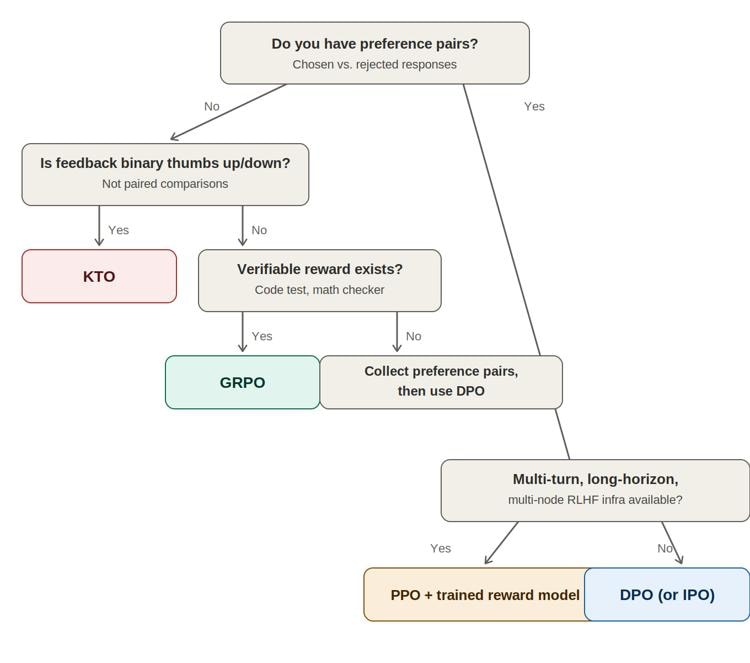
Direct Preference Optimisation, introduced by Rafailov et al., derives a closed-form policy update directly from pairwise preference data — a chosen response and a rejected response for the same prompt — without training a separate reward model or running an RL loop at all.
This is the core reason DPO converges faster and requires far less infrastructure than RLHF, and it has become the default preference-tuning method in most 2026 open-weight production pipelines for exactly that reason. Its known limitations are real, though: a documented tendency toward length bias, dependence on keeping a reference model copy during training, and the same underlying cost RLHF has — curating good preference pairs is genuinely expensive, even though the training step downstream of that data is cheap.
The DPO Family: KTO, SimPO, ORPO, IPO
DPO's limitations produced a cluster of successor methods, each addressing one specific gap rather than replacing DPO wholesale.
| Method | What It Changes | Best Fit |
|---|---|---|
| KTO | Trains on unary (thumbs up/down) feedback instead of paired comparisons | Production systems where binary feedback is abundant but preference pairs are expensive to curate |
| SimPO | Removes the reference model entirely, using average log-probability as an implicit reward | Teams that want DPO's simplicity without the memory cost of a frozen reference copy |
| ORPO | Combines the SFT and preference optimisation stages into one training objective | Teams that want to collapse two training stages into one for simpler pipelines |
| IPO | Adds regularisation to prevent DPO's preference margin from growing unbounded | Cases where DPO has shown a tendency to overfit on the training preference pairs |
GRPO and Verifiable Rewards: A Different Problem Entirely
GRPO (Group Relative Policy Optimisation) keeps an online RL loop but removes the separate critic model, instead sampling a group of completions per prompt and computing each one's advantage relative to the group. It is best suited to tasks with a verifiable, programmatically checkable reward — passing a code test, matching a math answer, satisfying a structured validation rule — which is a genuinely different problem from subjective preference alignment.
For Agentic AI systems specifically, this matters for any agent whose output can be automatically checked: a coding agent, a tool-calling agent where correct parameter structure can be validated, or a structured extraction agent like the one in Part 5. It is not the right tool for shaping subjective qualities like tone, which is precisely the DPO family's territory.
Where Classical RLHF Still Wins
DPO has not made RLHF obsolete, and 2026 practice increasingly frames this as a use-case decision rather than an ideological one. Classical RLHF and PPO remain the stronger choice for:
- Multi-objective control where several competing reward signals need active balancing.
- Federated or privacy-preserving deployments where feedback can't be centralised into static preference pairs.
- Online production adaptation where the policy needs to keep updating against a live reward signal.
- Sparse-reward domains requiring genuine exploration rather than imitation of existing preferences.
One frequently cited academic comparison found PPO modestly outperforming DPO on math and general benchmarks when data quality was held constant — a reminder that DPO's practical advantages are about cost and simplicity, not a guarantee of higher raw quality in every case.
There is also a regulatory dimension worth flagging rather than treating as settled: some 2026 industry analysis frames DPO's reproducibility as an advantage for documentation-heavy compliance regimes such as the EU AI Act, while RLHF's federated patterns are framed as better suited to privacy-preserving feedback collection. This is a fast-moving and jurisdiction-specific area — treat it as a factor to discuss with legal and compliance counsel for your specific market, not as settled guidance from this article.
Financial Research Agent: Where Tone and Citation Discipline Needed Real Alignment
An investment research team built an agent to draft first-pass summaries of company filings and market data for their analysts. Prompting handled most of the structural requirements well — a five-layer prompt from Part 2 defined the role, an output schema, and guardrails against making forward-looking recommendations the firm wasn't licensed to give.
But two subtler problems persisted across nearly every output regardless of how the prompt was tuned: the agent's tone drifted toward more confident, promissory language than the compliance team was comfortable with — phrasing that read more like a recommendation than an analysis — and its citation discipline was inconsistent, sometimes attributing a claim to a specific filing and sometimes stating it without any attributable source at all.
This was the genuine signal for preference alignment rather than more prompt iteration: a standing preference shift needed across every output, not a single task or format. The team already had a natural source of preference data — their own analysts were routinely editing draft outputs, and each edit implicitly created a rejected version (the original draft) and a chosen version (the analyst's edit) for the same underlying content.
Rather than building a reward model and running a full RLHF pipeline, the team curated a preference dataset from several hundred of these real edit pairs, specifically selecting for edits that corrected either tone or citation attribution, and ran DPO on top of the model that had already been through LoRA fine-tuning for the extraction and formatting task.
They evaluated the result against a held-out set of filings using both a citation-attribution accuracy check and an LLM-as-judge score for measured, non-promissory tone, confirming the shift was real and consistent rather than a few lucky examples. In production, the team also added a lightweight binary feedback signal — a simple accept or flag button analysts could use on any output — specifically because collecting new preference pairs for every model refresh was expensive, while binary feedback accumulated naturally as a byproduct of the analysts' actual workflow. This binary signal is being tracked as a candidate KTO-style dataset for the next round of alignment, rather than committing to a new full pairwise collection effort every cycle.
Enterprise Architecture Perspective
From an architecture perspective, preference alignment sits on top of everything else in this series rather than replacing any of it — the financial research agent still needed RAG for current filing data, prompt engineering for structure and guardrails, and LoRA fine-tuning for the extraction task itself. DPO's job was narrow and specific: shift the standing preferences the other layers weren't designed to fix.
Teams that reach for preference alignment to solve a problem better addressed by prompting or fine-tuning tend to end up with an expensive, hard-to-debug model that still needs the cheaper fix underneath it.
Best Practices
- Confirm the gap is a standing preference shift across many tasks, not a single-task or single-format problem better solved by prompting or LoRA fine-tuning.
- Look for preference data your organisation may already be generating naturally — edits, corrections, and accept/reject decisions — before commissioning a dedicated labelling effort.
- Start with DPO as the default for standard alignment needs; reach for GRPO specifically when a verifiable reward exists, and KTO when only binary feedback is realistically available.
- Evaluate the aligned model against the pre-alignment baseline on the specific preference dimension being targeted, not just general quality.
- Treat classical RLHF as justified by specific conditions — multi-objective control, federated deployment, sparse-reward exploration — not as a stronger default than DPO.
Anti-Patterns
- Reaching for preference alignment before confirming prompting and fine-tuning have genuinely been exhausted for the specific gap observed.
- Running full RLHF by default when DPO would meet the need at a fraction of the infrastructure cost.
- Committing to a new full preference-pair collection effort for every model refresh instead of using cheaper binary feedback signals where available.
- Treating DPO and RLHF as ideologically opposed rather than choosing based on the specific data and infrastructure available.
Frequently Asked Questions
Can DPO run on top of a model that already has a LoRA adapter?
Yes, and this is a common production pattern — continued pretraining, LoRA supervised fine-tuning, and preference alignment are typically layered in sequence rather than treated as alternatives to each other, as shown in Part 6's four-stage pipeline.
Is GRPO a replacement for DPO?
No, they solve different problems. GRPO is suited to tasks with a verifiable, checkable reward, like code or math correctness. DPO is suited to subjective preference alignment, like tone or citation habits, where correctness can't be automatically verified. Choose based on whether a verifiable reward function actually exists for the task.
How much preference data is actually needed for DPO?
There's no fixed number that applies universally — it depends on the scope of the behaviour being shifted and the quality of the pairs. Real, naturally occurring preference signals such as edit histories are generally worth more than a similarly sized set of synthetically generated pairs, and a focused, high-quality set in the low hundreds is a reasonable starting point to evaluate before assuming more data is needed.
Key Takeaways
- Preference alignment shifts standing response preferences across many tasks; it does not add new knowledge or teach a single task format.
- DPO has become the default for most production alignment in 2026 because it skips the reward model and RL loop entirely, at the cost of needing curated preference pairs.
- KTO, SimPO, ORPO, and IPO each address a specific DPO limitation rather than replacing it wholesale; GRPO solves a different, verifiable-reward problem.
- Classical RLHF remains justified for multi-objective control, federated deployment, and sparse-reward exploration — specific conditions, not a stronger general default.
- Naturally occurring preference signals — edits, corrections, accept/reject feedback — are often available before a dedicated labelling effort is needed.
References for Further Reading
- Ouyang et al., "Training language models to follow instructions with human feedback" — the foundational RLHF/InstructGPT paper.
- Rafailov et al., "Direct Preference Optimization" — the foundational DPO paper.
- Ethayarajh et al., "KTO: Model Alignment as Prospect Theoretic Optimization" — the foundational KTO paper.
- Shao et al., the DeepSeekMath paper introducing GRPO, and the DeepSeek-R1 work that popularised it for reasoning tasks.
- Current EU AI Act guidance and your own legal counsel — for the regulatory dimension of alignment method choice, check current official guidance rather than this article.
Coming Next
Part 8, the final part of this series, covers full fine-tuning and pretraining from scratch — the narrow, specific conditions under which enterprises genuinely need them, and a buy-versus-build framework for the whole series.