
Fine-Tuning with LoRA and QLoRA: Production Practice for a High-Volume Extraction Agent
Part 5 of 8: A production guide to LoRA and QLoRA fine-tuning for Agentic AI — hyperparameters, data curation, catastrophic forgetting, evaluation gates, and a high-volume structured data extraction agent story. The first method in this series that actually changes model weights.
*Series: LLM Training & Tuning for Agentic AI — Part 5 of 8*
*Parts 1–4 covered the decision framework, prompt engineering, RAG, and agent memory. This part goes deep on Step 4 — LoRA and QLoRA fine-tuning, the first method in this series that actually changes model weights — with a high-volume structured data extraction agent as the working example, current as of mid-2026.*
Executive Summary
By the time a team reaches this step in the decision framework, prompting and RAG have already been tried and have already fallen short on one specific, well-defined task — usually a persistent format, schema, or domain-vocabulary failure that no amount of prompt iteration closes. LoRA and its quantized variant QLoRA are now the default entry point for that gap: parameter-efficient fine-tuning that trains a small set of adapter weights on top of a frozen base model, recovering most of full fine-tuning's task performance at a fraction of the compute, cost, and risk.
This article covers how LoRA and QLoRA actually work, the hyperparameter choices that matter in practice, the data curation and catastrophic-forgetting discipline that determines whether a fine-tune helps or quietly degrades the model, the evaluation gate that should sit between training and production, and walks through what this looks like for a real high-volume structured data extraction agent.
Introduction
In enterprise environments, fine-tuning earns its place at Step 4 of the decision framework, not Step 1, because it is the first method in this series that requires labeled data, a training run, and ongoing model lifecycle management — real costs that prompting and RAG don't carry. The signal that a task belongs here is specific: the model consistently fails at one well-defined task — a structured output schema, a tool-call format, a domain-specific classification — even with a well-designed prompt and good retrieval in place. If the failure is knowledge rather than behavior, that's still a RAG problem from Part 3, not a fine-tuning one.
How LoRA Works
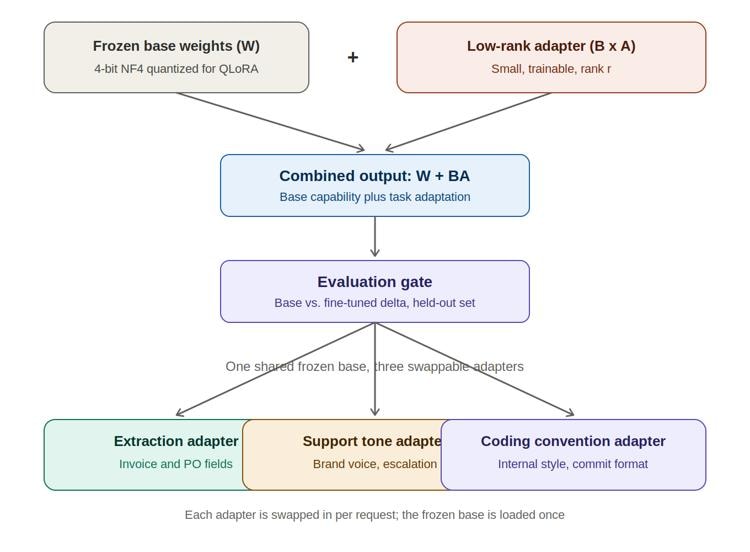
LoRA freezes the base model's original weight matrices entirely and adds a small pair of trainable low-rank matrices alongside each targeted weight. Rather than updating a full weight matrix directly, training learns two much smaller matrices whose product approximates the needed update, which is why the trainable parameter count drops by orders of magnitude compared to full fine-tuning — commonly cited estimates put the reduction at up to roughly 10,000x fewer trainable parameters, though the exact figure depends on model size and which layers are targeted.
At inference time, the frozen base weights and the low-rank update are combined, so the adapter behaves as a small, swappable addition to the base model rather than a replacement for it. Industry practice in 2026 generally reports LoRA recovering somewhere in the 90–95% range of full fine-tuning's task performance for most tasks — a useful planning heuristic, though it should be verified against your own evaluation rather than assumed.
How QLoRA Extends This
QLoRA quantizes the frozen base model's weights down to 4-bit precision using NF4 quantization, then trains the same style of low-rank adapters on top in higher precision. This dramatically cuts the GPU memory required to hold the base model during training, which is what makes it realistic to fine-tune a 70-billion-parameter class model on a single high-end GPU rather than requiring a distributed training cluster.
The tradeoff is a small amount of additional quantization error relative to full-precision LoRA, which in practice is rarely the limiting factor for enterprise task-specific fine-tuning.
Hyperparameters That Actually Matter
The following are commonly cited 2026 starting points for QLoRA on 7–13B class models — treat them as a starting point to validate against your own evaluation set, not a fixed recipe.
| Parameter | Common Starting Point | Notes |
|---|---|---|
| LoRA rank (r) | 16 for style tasks, 32 for general SFT, 64 for complex or coding tasks | Higher rank costs modest extra memory and rarely hurts quality |
| LoRA alpha | Roughly 2× the rank | Scales the adapter's effective learning strength |
| Target modules | Attention and MLP layers together | Attention-only targeting tends to underperform |
| Learning rate | Around 2e-4 with cosine schedule and brief warmup | Full fine-tuning uses a much lower rate, roughly 1e-5 to 5e-5 |
| Epochs | 2–3 for instruction-style tuning on 5,000–50,000 examples | Watch held-out eval loss; more epochs overfit quickly on small sets |
| Effective batch size | 16–64 via gradient accumulation | Smaller batches often generalize surprisingly well with LoRA |
Data Curation and Catastrophic Forgetting
Data quality outweighs data quantity in fine-tuning, and this isn't a new claim — it echoes the widely cited LIMA finding that a smaller set of carefully curated examples can outperform a much larger set of noisy ones. For an enterprise extraction or classification task, this means investing in reviewing several hundred to a couple thousand genuinely representative, correctly labeled examples is usually worth more than scraping together tens of thousands of unreviewed ones.
Catastrophic forgetting — the fine-tuned model losing general capability it had before training — remains a real risk, though LoRA reduces it structurally since the original weights are never overwritten. The practical mitigations that matter: keep the learning rate conservative, avoid excessive epochs on a narrow dataset, and mix a modest proportion of general-instruction examples into the training set alongside the task-specific data, so the model doesn't drift away from baseline instruction-following while learning the new task.
The Evaluation Gate
A fine-tuned model should never reach production without a direct comparison against the base model on an identical held-out set — not just task-specific metrics, but a check for regressions in general instruction-following and tool-call correctness that the fine-tune might have introduced.
Current practice combines task metrics (exact schema match rate, classification accuracy) with LLM-as-judge scoring for qualities like faithfulness and instruction adherence that are harder to measure with a simple exact-match score. The model should only ship if the delta between the fine-tuned candidate and the base model is real and reproducible on this held-out set, not inferred from a handful of spot checks.
Full Fine-Tuning vs. LoRA/QLoRA: When Full Still Wins
| Consideration | LoRA / QLoRA | Full Fine-Tuning |
|---|---|---|
| Trainable parameters | A small fraction of the base model | All parameters |
| Hardware requirement | Single high-end GPU feasible even for large base models | Multi-GPU or distributed training typical for large models |
| Multi-task serving | One base model, many swappable adapters | Separate full model copy per task |
| Best fit | The large majority of enterprise task-specific fine-tuning needs | Deep, pervasive behavior change across nearly all outputs, or extreme-scale serving where adapter overhead itself becomes a constraint |
| Typical enterprise share | Roughly 90–95% of cases by current industry consensus | A narrow remainder, covered further in Part 8 |
Tooling Landscape
As of mid-2026, Hugging Face's PEFT and TRL libraries, Unsloth, and Axolotl are the most commonly used open-source tooling for running LoRA and QLoRA fine-tunes, with DeepSpeed used for larger-scale or distributed training needs. This tooling landscape moves quickly; check current documentation and benchmarks before committing to a specific framework for a long-lived production pipeline.
A High-Volume Extraction Agent: From Prompting Failure to a Shipped Adapter
A logistics company's operations team processes several thousand vendor invoices and shipping manifests a day, and needs a JSON object out of each one — vendor name, line items, quantities, totals, currency, and a shipment reference number — feeding directly into their accounting system.
The team's first attempt was a well-built prompt against a capable general-purpose model, following the five-layer structure from Part 2: role, few-shot examples, an explicit output schema, guardrails, and a trust boundary for the untrusted document content. It worked well on the clean, standardized invoices from their top vendors and degraded noticeably on the long tail — inconsistent formatting from smaller vendors, handwritten annotations scanned into PDFs, and line-item tables that didn't match any of the few-shot examples.
Because this was a narrow, well-defined, high-volume task with a stable schema — exactly the profile that graduates from prompting to fine-tuning in the decision framework — the team built a curated training set: roughly 1,500 invoices spanning their messiest real vendor formats, hand-verified against the correct extracted JSON, deliberately weighted toward the failure cases the prompt-only approach struggled with rather than toward the easy majority. They fine-tuned a QLoRA adapter on an open-weight model in the 8-billion-parameter class, targeting both attention and MLP layers, at a rank suited to the schema's complexity, mixing in a small proportion of general instruction-following examples to guard against forgetting.
Before shipping, the team ran the fine-tuned adapter against the same held-out set as the base model: exact-schema match rate on the messy long-tail invoices rose substantially, general instruction-following on an unrelated evaluation set stayed flat rather than degrading, confirming the mix-in strategy had done its job.
In production, the fine-tuned small model now handles the bulk of daily volume at a fraction of the inference cost and latency of the original general-purpose model, with only genuinely ambiguous documents — illegible scans, multi-currency edge cases — routed to a human reviewer, flagged by the same corrective-check discipline used in the RAG pipeline from Part 3: if the model's own confidence signal is low, it defers rather than guessing.
Best Practices
- Confirm the failure is genuinely a fine-tuning problem — narrow, well-defined, and already resistant to good prompting and retrieval — before collecting any training data.
- Curate a few hundred to a couple thousand representative, correctly labeled examples, weighted toward known failure cases, rather than maximizing volume.
- Target both attention and MLP layers, not attention alone, and start from commonly cited rank and learning-rate defaults before tuning further.
- Mix in general-instruction examples to guard against catastrophic forgetting, and verify with a held-out general-capability check, not just the task metric.
- Gate every fine-tuned candidate behind a direct comparison against the base model on an identical held-out set before shipping.
Anti-Patterns
- Fine-tuning before confirming that prompting and RAG have genuinely been exhausted for the specific failure observed.
- Maximizing training data volume over data quality, diluting a curated set with noisy or unverified examples.
- Training for too many epochs on a small dataset and overfitting without a held-out eval loss check to catch it.
- Shipping a fine-tuned model without a direct base-vs-fine-tuned comparison, relying on the training loss curve alone.
Frequently Asked Questions
How much data do I actually need to fine-tune with LoRA?
Current guidance generally points to fine-tuning becoming worthwhile with several hundred high-quality examples at minimum, with most enterprise tasks well served by a curated set in the low thousands. More matters far less than correctness and representativeness of the examples you have.
Does LoRA fine-tuning eliminate the risk of catastrophic forgetting?
It reduces the risk structurally, since the original weights are never overwritten, but it does not eliminate it. A high learning rate, too many epochs, or a training set with no general-instruction examples mixed in can still measurably degrade base capability.
Can a fine-tuned small model really beat a larger general-purpose model on cost?
For narrow, well-defined tasks at high volume, yes — this is one of the more consistent findings in current practice. A smaller fine-tuned model matched to the specific task can match or exceed a much larger general-purpose model's accuracy on that task while running at meaningfully lower inference cost and latency.
Key Takeaways
- LoRA and QLoRA are the default fine-tuning choice for the large majority of enterprise Agentic AI tasks; full fine-tuning is the narrow exception, covered in Part 8.
- Data curation quality determines fine-tuning outcomes more than data volume — a few hundred well-verified examples can outperform a much larger noisy set.
- Catastrophic forgetting is a real, manageable risk — conservative learning rates, controlled epochs, and general-instruction mix-in are the practical defenses.
- No fine-tuned model should ship without a direct, held-out comparison against the base model covering both the task metric and general capability.
- A fine-tuned small model frequently beats a larger general-purpose model on cost and latency for narrow, high-volume production tasks.
References for Further Reading
- Hu et al., "LoRA: Low-Rank Adaptation of Large Language Models" — the foundational LoRA paper.
- Dettmers et al., "QLoRA: Efficient Finetuning of Quantized LLMs" — the foundational QLoRA paper covering NF4 quantization.
- Zhou et al., "LIMA: Less Is More for Alignment" — the data-curation-over-volume finding referenced above.
- Hugging Face PEFT and TRL, Unsloth, and Axolotl documentation — for current tooling specifics, check live documentation rather than this article.
Coming Next
Part 6 covers continued pretraining for domain-specific agents, using a compliance and regulatory review agent as the working example — including when domain vocabulary gaps genuinely justify this more expensive step.